News
2026 LA Dodgers Andy Pages Kike Hernandez “The Catch” Bobblehead Giveaway: Complete Collector Guide
Jul
Some baseball collectibles celebrate an athlete’s entire career. Others preserve one unforgettable play so important that the championship story would feel incomplete without it. The 2026 LA Dodgers Andy Pages Kike Hernandez The Catch Bobblehead Giveaway belongs to the second category.
Rather than presenting two Dodgers players in a standard standing pose, this collectible recreates the instant Andy Pages secured a deep fly ball while colliding with Kiké Hernández during the bottom of the ninth inning of Game 7 of the 2025 World Series.
That split second carried enormous weight. The bases were loaded, two outs were recorded, and the game was tied. A dropped ball could have ended the Dodgers’ season immediately. Pages held on, the game moved into extra innings, and Los Angeles eventually completed its championship victory in the 11th.
The resulting bobblehead is not simply a figure featuring two popular Dodgers. It is a compact visual record of concentration, risk, teamwork, and survival under the most intense conditions baseball can create.
A Dodgers Bobblehead Built Around One Decisive Second
The central strength of “The Catch” bobblehead is its focus. It does not attempt to summarize an entire season through trophies, statistics, championship rings, or a generic victory pose. Instead, the design isolates the exact moment when the Dodgers remained alive.
That decision gives the collectible a natural sense of movement. Andy Pages reaches upward with his glove as Kiké Hernández enters the same space from behind. Their bodies overlap, their balance appears unstable, and the baseball sits at the highest point of the composition.
The danger of the play is clear even to someone who did not watch the original broadcast. Two defenders are moving at full speed toward the same ball, contact is unavoidable, and the catch is completed at the instant they collide.
This action-based structure separates the piece from conventional single-player bobbleheads. A traditional figure usually celebrates identity through the uniform, player number, facial expression, and recognizable batting or fielding stance. “The Catch” celebrates an event.
Pages and Hernández matter individually, but the deeper subject is the play itself.
The World Series Story Behind “The Catch”
The bobblehead refers to Game 7 of the 2025 World Series between the Los Angeles Dodgers and Toronto Blue Jays.
In the bottom of the ninth inning, Toronto had the bases loaded with two outs when Ernie Clement drove a deep fly ball toward left-center field. Pages and Hernández both pursued it. They collided as Pages reached above his teammate, but Pages maintained control and completed the catch.
That final out sent the tied game into extra innings. Los Angeles later won in the 11th inning to secure a second consecutive World Series championship.
The sequence explains why this defensive play became instantly recognizable. It was not merely an impressive catch during an ordinary regular-season game. It occurred with no margin for error. The inning, score, baserunner situation, and championship stakes transformed the play into a direct barrier between survival and defeat.
Baseball history often remembers home runs because their outcomes are immediate and easy to measure. Defensive plays can be more difficult to preserve. Their value depends on positioning, reaction time, communication, movement, and control under pressure.
Pages’ catch contained all of those elements. The visible collision with Hernández also made the play dramatic enough to become an enduring image rather than simply another line in a box score.
Detailed Design of the Andy Pages and Kiké Hernández Bobblehead
The product uses a dual-player action format to reconstruct the collision and catch.
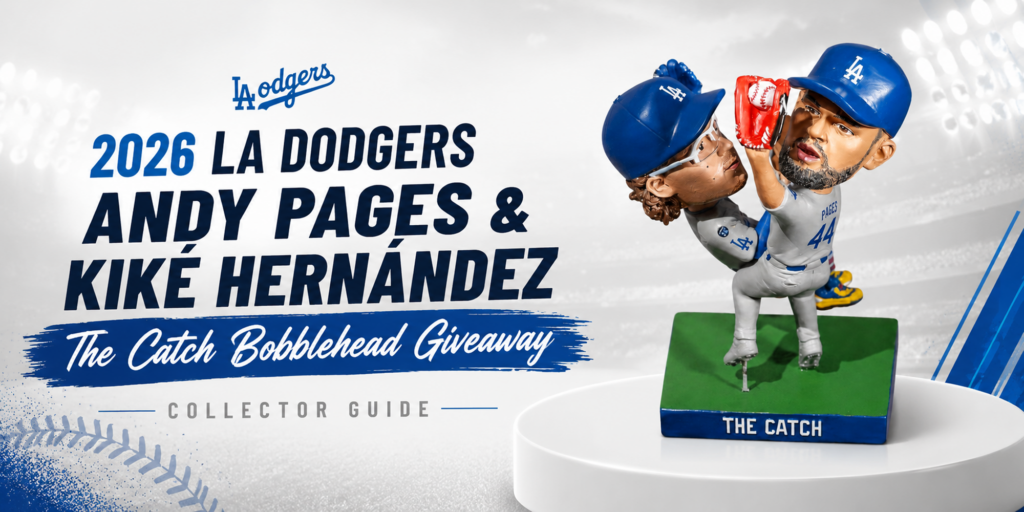
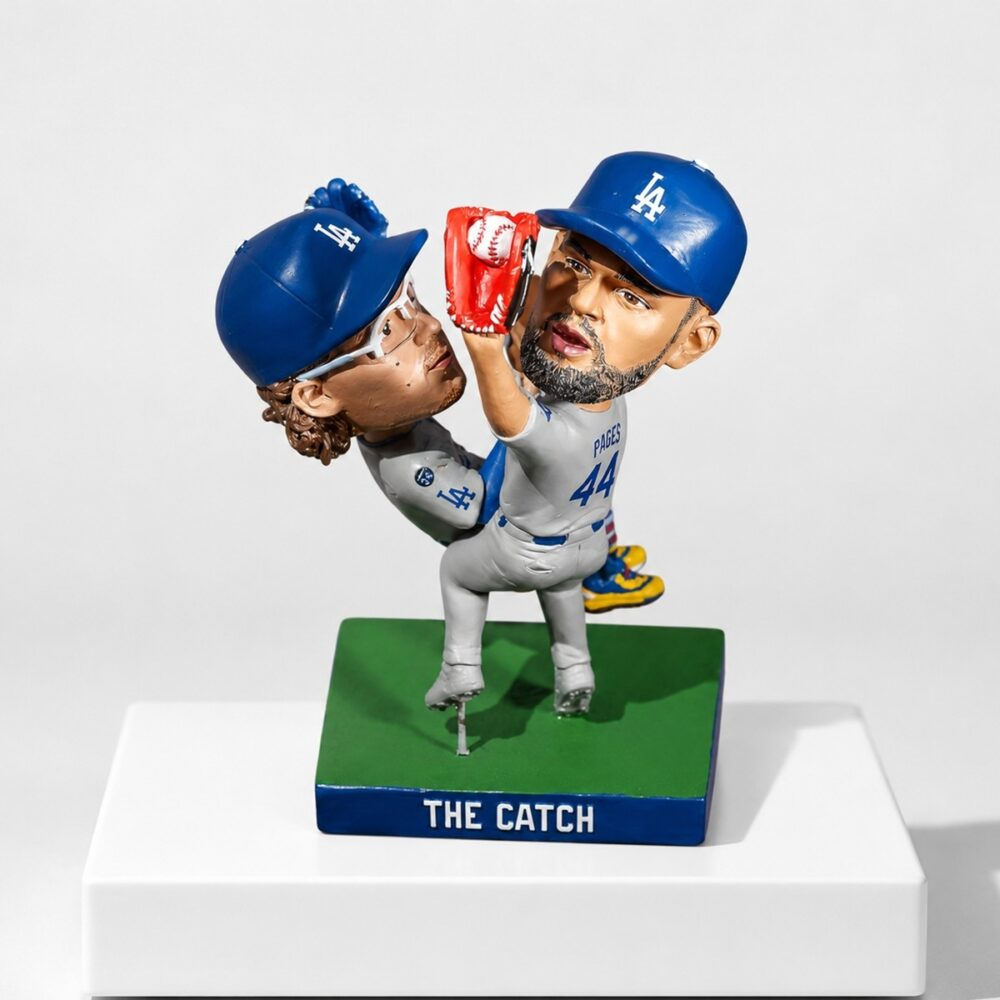
Andy Pages appears at the front of the scene in a gray Dodgers road uniform, wearing number 44 and a blue Los Angeles cap. His red glove is raised above his head, with the baseball secured inside it.
Kiké Hernández is positioned directly behind him in a matching gray uniform, blue cap, protective eyewear, and brightly colored cleats. Both players stand above a green field-style platform with a deep blue border and the words “THE CATCH” displayed across the front.
Every major element supports the same story. The raised glove communicates success. The overlapping players communicate danger. The visible baseball confirms the result. The field base establishes the setting, while the front lettering gives the moment a permanent name.
Andy Pages as the Visual Center
Pages is placed at the highest and most visually dominant point of the design. His raised glove immediately directs attention upward, while the baseball provides a clear focal point.
His posture communicates extension rather than comfort. He is not standing upright after completing a routine defensive play. His body appears fully committed, with the glove elevated above the collision zone.
The red glove creates a strong contrast against the gray uniform and blue cap. More importantly, it frames the baseball. In a design based on a fast defensive moment, viewers need to identify the successful catch immediately. Placing the ball inside a brightly colored glove allows the story to be understood from the first glance.
The number 44 also helps connect the front figure specifically to Andy Pages. Because two players occupy the same compact scene, individual uniform details prevent the composition from becoming visually confusing.
Pages remains clearly identifiable as the player who secured the final out of the ninth inning.
Kiké Hernández and the Collision
Hernández is not treated as a minor background detail. His placement creates the tension that defines the entire piece.
He moves into the same path as Pages, visually recreating the difficult communication problem that can occur when two outfielders chase a ball into shared space. His protective eyewear, cap, uniform details, and colorful footwear give the second figure a distinct identity.
The overlap between the players creates depth, while the angle of Hernández’s body makes the scene feel interrupted by impact. This is important because the original play is remembered not only for the catch, but also for the fact that Pages maintained control through contact with his teammate.
A simpler design might have shown Pages alone with his glove raised. Including Hernández makes the bobblehead more faithful to the emotional memory of the play.
The collision is the reason viewers hold their breath. The secured baseball is the reason they can finally exhale.
The Raised Glove and Visible Baseball
The highest point of the collectible carries the most important information.
Pages’ glove is fully extended above the two players, separating it from the physical confusion below. The baseball remains visible inside the glove, creating a clear visual answer to the question at the center of the scene: Did he hold on?
Yes, he did.
This detail gives the design a strong visual hierarchy. The viewer first notices the glove and baseball, then follows the figures downward through the collision, uniforms, and field base.
That order closely matches the way supporters remember the original play. They first watched the ball descend, then saw the two players collide, and finally waited for confirmation that Pages had maintained control.
The Green Field Base
The rectangular base uses a green playing-surface treatment surrounded by a dark blue edge. This provides visual separation between the figures and the shelf, table, or display cabinet beneath them.
It also places the scene inside a recognizable baseball environment without using a large stadium backdrop that could distract from the players.
The compact field treatment allows the movement of the figures to remain central. Pages and Hernández are not surrounded by unnecessary scenery. The composition stays focused on the route to the ball, the impact, and the completed catch.
The “THE CATCH” Nameplate
The words “THE CATCH” appear prominently across the front of the base.
This is more than decoration. It turns the base into a caption, allowing the collectible to function as a self-contained story. Someone unfamiliar with the original play can identify its subject, while a Dodgers supporter can immediately connect the phrase to the Game 7 moment.
The nameplate also gives the defensive play an identity comparable to other famous moments in baseball history. Instead of being remembered through a long description, the event can be summarized in two words.
“The Catch” becomes the name of the play and the title of the collectible.
Available Display Sizes
The listed product provides several display options.
Collectors can select a compact 9–10 cm version with or without a box. An 18 cm version is also listed for buyers who prefer a larger presentation with more visual presence.
The smaller format can fit naturally on a desk, narrow shelf, bookcase, or display area containing several Dodgers figures. The larger option gives the raised glove, overlapping players, uniform details, and field base more room to be seen from a distance.
Box preference is another consideration. A boxed selection can support organized storage or a more structured memorabilia display. An unboxed version allows the complete action scene to be viewed immediately from several angles.
The best choice depends on the available display area and whether the buyer plans to keep the collectible enclosed or present it as an open centerpiece.
Why the Two-Player Format Matters
A dual-player bobblehead is structurally more complex than a traditional figure, but the format serves the story.
The catch cannot be fully explained through Pages alone because the collision is central to its meaning. The two players represent separate defensive instincts converging at the same moment. Both recognized the danger, both committed to the ball, and Pages completed the play despite the contact.
This structure introduces a layer of teamwork that a solo pose would miss.
Baseball assigns defensive responsibility through positioning and communication, but high-pressure plays are not always clean. “The Catch” shows teamwork in an urgent and imperfect form. The players do not appear synchronized like athletes completing a rehearsed celebration. They appear fully committed to preventing the ball from dropping.
That realism gives the collectible emotional weight. It honors the successful execution while preserving the chaos surrounding it.
Why This Dodgers Collectible Has Cultural Meaning
The cultural value of the bobblehead comes from what the play represents within modern Dodgers history.
It is connected to a Game 7, a bases-loaded ninth inning, a collision in the outfield, and a championship that required extra innings. The catch became a visual symbol of a team refusing to let its season end.
For Los Angeles supporters, the image represents the difference between remembering a championship as inevitable and remembering how close it came to disappearing.
Successful teams are often discussed through star power, statistics, payroll, and season-long performance. This play tells a more immediate human story. A title was preserved because a player tracked a difficult ball, reached through traffic, absorbed contact, and maintained control.
The presence of Kiké Hernández adds another important layer. He is not simply placed beside Pages for recognition. He is part of the physical danger, urgency, and collective effort that made the play memorable.
Pages, meanwhile, becomes permanently connected to one of the defining defensive moments of the championship. The collectible places both players inside the same historical frame.
Why “The Catch” Bobblehead Appeals to Collectors
Sports memorabilia collections are often organized around specific categories. Some focus on favorite players. Others document championship seasons, stadium giveaways, postseason moments, unusual designs, or memorable games.
“The Catch” can connect several of those categories at once.
It belongs naturally beside other memorabilia from the 2025 World Series because it represents a specific turning point rather than repeating a broad championship message. It can also anchor a Dodgers bobblehead shelf containing individual players from the same era.
Among rows of upright figures, the overlapping action pose creates a noticeably different silhouette. The raised glove and two-player structure immediately signal that this piece tells a more detailed story.
The collectible may also interest supporters who do not maintain large memorabilia collections. The moment is easy to explain because it has a clear beginning, crisis, and result.
Toronto threatened to win. Two defenders converged. Pages caught the ball. Los Angeles survived and later became champion.
That narrative clarity allows one object to carry meaningful context without requiring an entire display of related items.
A Collectible About Defense Rather Than Power
Many baseball collectibles focus on hitting. Players are commonly shown holding bats, finishing swings, crossing home plate, or celebrating home runs.
“The Catch” takes a different approach by giving a defensive play the same level of visual importance normally reserved for a dramatic hit.
That distinction matters because championships are not won through offense alone. Defensive positioning, communication, tracking, glove control, and concentration can determine a season just as directly as a home run.
The design recognizes that reality. Its most important object is not a bat or championship trophy. It is a glove containing a baseball.
The message is clear: keeping the ball from touching the ground was the action that mattered most.
How to Display the Bobblehead Clearly
Because the design includes two overlapping players and a raised glove, viewing angle matters.
Positioning the figure slightly below eye level allows the viewer to see the baseball, Pages’ glove, Hernández’s movement, and the “THE CATCH” lettering together. A straight-on view emphasizes the nameplate and collision, while a slight side angle reveals more separation between the two figures.
Avoid crowding the piece between taller objects. The raised glove is the highest point and should remain visually clear. Leaving open space around the upper half of the bobblehead helps preserve the feeling of extension that defines the pose.
For a championship-themed arrangement, the figure can be placed near a World Series program, game ticket, framed photograph, or other Dodgers postseason item.
For a player-focused shelf, it can sit between individual Andy Pages and Kiké Hernández memorabilia. The action scene then functions as the visual connection between the two players.
A dark or neutral background can help the gray uniforms, blue caps, green platform, and red glove remain easy to distinguish. Strong reflections or visually busy backgrounds may make the overlapping figures harder to read.
Basic Display and Care Guidance
Handle the collectible by its base rather than the raised glove, arms, or heads. Extended elements are visually important and should not be used as lifting points.
Dust can be removed gently with a soft, dry cloth. Avoid placing the figure near moisture, direct sunlight, intense heat, unstable shelf edges, or areas where it may be frequently bumped.
When moving the bobblehead, support the bottom of the base with one hand. If the collectible includes a storage box, keep the packaging in a dry location so it remains available if the item needs to be moved or stored later.
These simple steps help protect the details that make the design recognizable, especially the raised glove, visible baseball, player overlap, and front nameplate.
2026 Dodgers Giveaway Event Details
The Los Angeles Dodgers’ official promotions calendar lists “The Catch” Bobblehead featuring Andy Pages and Kiké Hernández as a stadium-wide giveaway for Sunday, September 6, 2026, against the Washington Nationals.
The game is scheduled for 7:10 p.m. Pacific Time at UNIQLO Field at Dodger Stadium in Los Angeles.
The official promotion states that the giveaway is limited to 40,000 units while supplies last at each guest’s point of entry. One item is available per person, per valid ticket when entering the stadium. The Dodgers also note that promotional schedules can change without notice.
This is an important distinction for attendees. A valid game ticket provides eligibility for the stadium-wide giveaway while supplies remain, but it does not guarantee that every arriving guest will receive an item.
Gate inventory, arrival time, ticket validity, and updated stadium policies can affect availability. Anyone planning to attend should review the Dodgers’ official promotions calendar and game information before traveling.
Why the September 6 Giveaway May Draw Strong Interest
The giveaway connects a highly recognizable postseason moment with a less common dual-player bobblehead design.
It also arrives during a Sunday home game against the Washington Nationals, giving local supporters and visiting collectors an opportunity to receive an item tied directly to the Dodgers’ championship story.
Demand may also be influenced by the timing of the announcement. The Dodgers publicly revealed the design in July 2026, emphasizing the collision, completed catch, and September 6 distribution date.
Collectors who plan to attend should account for the stated 40,000-unit limit. Stadium-wide promotions can attract people who arrive earlier than they normally would for a standard game, especially when the item commemorates a recent championship moment.
Quick Answers for Dodgers Fans and Collectors
What does “The Catch” bobblehead depict?
It depicts Andy Pages securing the final out of the ninth inning in Game 7 of the 2025 World Series while colliding with Kiké Hernández in the outfield.
Why was the play important?
Toronto had the bases loaded with two outs in a tied ninth inning. Completing the catch prevented the winning run from scoring and sent Game 7 into extra innings. The Dodgers later won in the 11th inning.
Which players appear in the bobblehead?
The design features Dodgers outfielder Andy Pages at the front with his glove raised and Kiké Hernández directly behind him during the collision.
Why is it called “The Catch”?
The title refers to Pages maintaining control of the baseball through the outfield collision, recording the final out of the ninth inning and preserving the Dodgers’ championship opportunity.
When is the official Dodgers giveaway?
The Dodgers list the giveaway for Sunday, September 6, 2026, during the home game against the Washington Nationals.
What time is the game?
The scheduled first pitch is 7:10 p.m. Pacific Time.
Is a special event ticket required?
The promotion is listed as a stadium-wide giveaway rather than a separate special-event ticket package. One item is available per person with a valid game ticket while supplies last.
How many giveaway units are planned?
The official promotions page states that the giveaway is limited to 40,000 units while supplies last.
What makes the design different from a normal player bobblehead?
It recreates a complete two-player action sequence rather than presenting one athlete in a static pose. The collision, raised glove, visible baseball, field base, and “THE CATCH” nameplate work together to tell the story.
What size options are listed online?
The product listing includes 9–10 cm boxed and unboxed selections, along with an 18 cm version.
Where to Buy the 2026 LA Dodgers “The Catch” Bobblehead
Collectors who cannot attend the September 6 game, prefer a specific display size, or want to compare boxed and unboxed selections can search for the complete product title at Bigfirefashion.com.
The product page presents the available size options and multiple product views, allowing buyers to examine the raised glove, player positioning, uniforms, field base, and front lettering before ordering.
Before completing checkout, review the selected size, box option, quantity, delivery address, estimated processing period, and current store policies.
Because screen settings can affect the appearance of colors, examine the complete image gallery rather than relying on one thumbnail. Buyers should also confirm that the title matches “2026 LA Dodgers Andy Pages Kike Hernandez The Catch Bobblehead Giveaway” to avoid confusing it with a separate single-player Andy Pages or Kiké Hernández collectible.
The official stadium giveaway and an independently purchased display version should be evaluated separately. Attending the game involves ticket and stadium-entry requirements, while ordering online allows buyers to select from the options shown on the product page.
Conclusion
The 2026 LA Dodgers Andy Pages Kiké Hernández “The Catch” Bobblehead succeeds because it preserves more than a player pose.
It captures the physical and emotional structure of a championship-saving play: two defenders converging, one glove reaching above the collision, the ball remaining secure, and an entire season continuing into extra innings.
Every important design choice supports that story. Pages occupies the visual center with number 44 and the raised red glove. Hernández creates movement and danger from behind. The field-style base establishes the setting, while “THE CATCH” gives the moment a permanent name.
Together, those elements turn a few seconds of Game 7 tension into an object that can still be understood long after individual statistics and inning-by-inning details fade from memory.
For Dodgers supporters, the collectible represents concentration under pressure and the narrow distance between elimination and a championship. For memorabilia collectors, it offers an unusual dual-player composition connected to a clearly documented postseason moment.
Whether someone receives the official stadium giveaway or chooses a separately purchased display version from Bigfirefashion, the design carries the same essential message: the Dodgers’ 2025 championship opportunity survived because Andy Pages held on.
