
News
2026 49ers Daejon Love Football Jersey: The Story Behind the Viral No. 7 Design
Sep
Some jerseys honor a championship season, a record-setting play, or a familiar name from a team roster. The 2026 49ers Daejon Love Football Jersey comes from a very different corner of sports culture. It is a novelty piece connected to a widely discussed August 2026 news story, then transformed by social media into a recognizable visual reference. With a red football silhouette, a bold white number 7, and “LOVE” across the back, the jersey is designed to be noticed and understood by people who followed the story online.
That context matters. This is not a conventional player jersey, and shoppers should not treat it as proof that Daejon Love played for San Francisco. It works instead as topical apparel: a wearable reference to a moment when sports imagery, online identity, breaking news, and meme culture collided. For buyers who appreciate conversation-starting designs, the appeal lies in that very specific meaning.
What Is the 2026 49ers Daejon Love Football Jersey?
The 2026 49ers Daejon Love Football Jersey is a red novelty football-style jersey featuring “LOVE” and the number 7. Its design refers to the online persona at the center of a federal case announced in August 2026. Daejon Love does not appear on the team’s current official roster, so the product is best understood as internet-culture commentary rather than official player memorabilia.
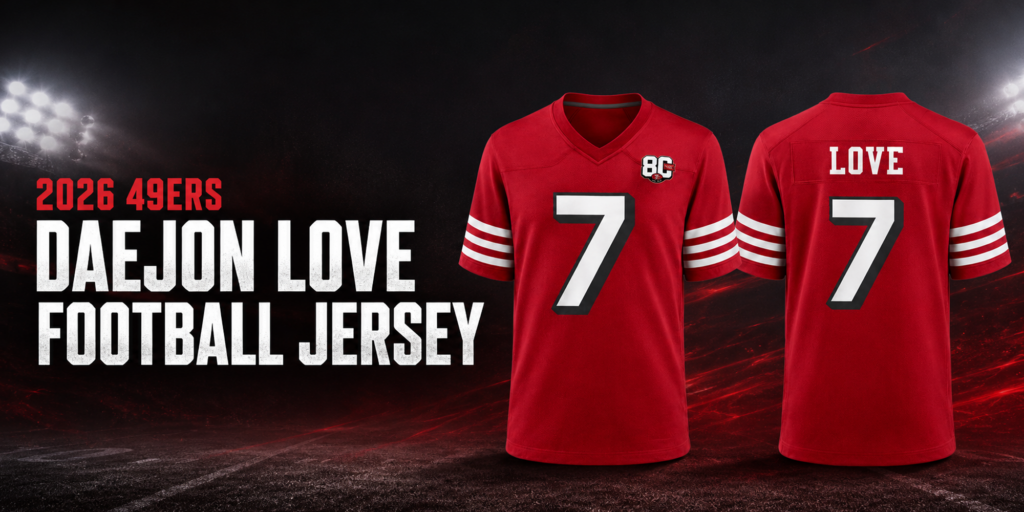
In visual terms, it communicates the reference immediately. The scarlet-red base evokes a familiar Bay Area football palette. Large white numerals give the front and back a classic game-day look, while dark edging helps the number stand out. White sleeve stripes strengthen the retro football character. On the back, the name and number create the clearest link to the viral story: “LOVE” sits above a large “7.”
This combination makes the jersey more than a generic red sports top. The name, number, color, and timing all work together. Someone who only sees the piece as streetwear can appreciate its bold athletic layout; someone familiar with the August 2026 headlines will recognize the joke and its deeper cautionary context.
A Detailed Look at the Front Design
The front centers on an oversized white number 7. A dark outline or shadow effect separates the numeral from the red body, making it readable from across a room, in a photograph, or in a short-form video. That high-contrast treatment is important because the number is not merely decoration; it is one of the design’s main identifiers.
Near the upper chest, an anniversary-style emblem adds another layer of football visual language. It makes the jersey feel connected to the 2026 season and the broader heritage styling commonly seen around milestone years. The V-shaped neckline reinforces the football silhouette and keeps the upper front visually clean, allowing the chest number to remain the focal point.
The front is deliberately straightforward. It does not need a long slogan to explain itself. Red, white, the number 7, and the commemorative-style detail are enough to establish the sports reference. That restraint also makes the jersey easier to style than a graphic shirt crowded with text.
The Back: “LOVE” and Number 7
The back carries the most recognizable part of the product. “LOVE” appears in uppercase athletic lettering above another large white number 7, again defined by dark edging. The arrangement follows the visual hierarchy people expect from a football jersey: nameplate first, number second.
The wording has an intentional double meaning. “LOVE” is a surname in the story behind the design, but it is also one of the most instantly readable words in English. From a distance, the back can look like a confident, positive sports statement. Once the viewer understands the context, it becomes a piece of internet-era irony.
That contrast is why the back is likely to attract attention in photos. The typography is direct, the number is prominent, and the reference does not depend on small details. It works well for game-day gatherings, casual streetwear, themed parties, social posts, or any setting where a topical sports design can open a conversation.
Sleeve Stripes and the Classic Football Shape
White horizontal striping on each sleeve gives the jersey a traditional gridiron identity. The stripes balance the large front and back numbers and prevent the red body from looking too plain. They also help the piece read as football-inspired apparel even when the nameplate is not visible.
The overall silhouette is intended to look relaxed and athletic rather than formal. That makes it practical for layering over a basic tee or wearing as the top layer of a casual outfit. The strong color blocking also carries well on camera, which is useful for buyers planning to wear it in social content, watch-party photos, or fan-centered videos.
Because product photos, production batches, and screen settings can affect how colors and details appear, shoppers should review every available image on the listing before ordering. The visible front, back, sleeves, neckline, and patch placement should all be checked rather than assuming the garment matches an official on-field uniform.
The Real-World Story Behind the Jersey
The jersey’s meaning comes from a current legal story, so accuracy is essential. On August 25, 2026, the U.S. Attorney’s Office for the District of Oregon announced that Daejon Labrayae Love and Taylor Jamie Chan had been charged by criminal complaint with conspiracy to commit wire fraud and wire fraud. According to the government’s allegations, Love used fictitious personas and at times falsely presented himself as a San Francisco professional football player or a wealthy real estate investor.
The federal announcement says investigators identified 26 alleged victims and traced approximately $1.3 million received from them. It also states that the two men were apprehended at Boise Airport on August 24, 2026. These are allegations, not a conviction. As the U.S. Department of Justice release makes clear, a criminal complaint is an accusation, and every defendant is presumed innocent unless and until proven guilty.
The official San Francisco roster provides another important point of clarity: Daejon Love is not listed as a current player. The team’s official 2026 roster should be the reference for anyone checking active, reserve, and practice-squad personnel.
This distinction protects the article from repeating the very confusion that made the story spread. The jersey does not commemorate an established playing career. It references a claimed identity that became national news and then a subject of online discussion.
Why the Number 7 Became Part of the Conversation
The number 7 is central to the viral visual associated with the story. Online posts and discussions connected the number to the football persona, and audiences quickly began treating a “LOVE 7” jersey as shorthand for the entire episode. A name and number are especially powerful in sports culture because they condense identity into a format people understand at a glance.
That shorthand explains why the product does not require paragraphs of printed copy. The back nameplate and numeral do the work. For people who saw the story unfold, “LOVE 7” is the reference. For everyone else, the jersey still looks like a bold red football-inspired design.
The timing also matters. Topical apparel is most meaningful when it preserves the visual details people remember from the original moment. By using the same name-number pairing discussed online, the jersey captures the specific 2026 reference rather than offering a vague football joke.
Why This Jersey Went Viral
The short answer is simple: the jersey went viral because an extraordinary alleged impersonation story collided with one of America’s most recognizable forms of sports identity—the personalized football jersey. The “LOVE 7” design turned a complicated news event into a clear visual reference that could be recognized, photographed, shared, and discussed.
Several factors helped the idea travel quickly:
The underlying allegations were unusual enough to attract attention beyond regular football audiences.
A personalized jersey made the claimed identity visible and easy to remember.
The word “LOVE” created an ironic connection to the romantic relationships described in the federal allegations.
The number 7 gave online communities a consistent detail to repeat in jokes, comments, and custom-jersey discussions.
The red-and-white palette was immediately associated with San Francisco football culture.
Virality, however, should not erase the seriousness of the allegations or the experiences of the people described as victims. The most responsible way to wear or discuss the jersey is as commentary on online deception, misplaced trust, and the power of a convincing digital persona—not as an endorsement of alleged fraud.
More Than a Meme: What the Design Says About Online Identity
At its most meaningful, the jersey reflects how easily familiar symbols can create credibility. A team-colored uniform, a nameplate, a number, staged sports footage, and an online profile can look persuasive when presented together. Modern audiences often use visual signals to decide whether someone appears legitimate, even when those signals have not been independently verified.
That makes the jersey an unusually relevant artifact of 2026 internet culture. It points to a world in which identity can be assembled through images, search results, social posts, and borrowed status markers. Sports branding is powerful because it carries built-in ideas of achievement, wealth, discipline, and public recognition. The federal allegations suggest that this familiar visual language was used to build trust.
Worn with awareness, the piece can prompt a useful conversation: verify claims, do not mistake polished content for proof, and approach unsolicited investment opportunities with caution. A novelty jersey cannot tell the whole story, but it can preserve the visual detail that caused many people to ask how online credibility is created in the first place.
Who Is This Jersey For?
This product is best suited to buyers who understand its context and want a topical conversation piece. It may appeal to collectors of viral-moment apparel, followers of unusual sports news, fans of internet culture, or people who enjoy jerseys with stories that extend beyond the field.
It can also work for someone who simply likes red football-inspired streetwear and the “LOVE 7” layout. Even then, knowing the background is important. Wearing a name associated with a pending criminal case can draw questions, and the wearer should be prepared to explain that it is a novelty reference rather than a legitimate player jersey.
This is probably not the right choice for someone seeking official team merchandise, an authentic rostered-player uniform, or a traditional collectible tied to documented game performance. Buyers in those categories should use official team and league stores and verify licensing before purchasing.
How to Style the LOVE No. 7 Jersey
The vivid red base makes the jersey the dominant piece in an outfit, so the rest of the look can stay simple. For an easy game-day combination, wear it with a white T-shirt, dark jeans, and neutral sneakers. The white layer echoes the numbers and sleeve stripes without competing with them.
For a streetwear approach, pair the jersey with loose black pants, a clean cap, and understated footwear. Wearing it open over a plain top creates a more relaxed shape and makes the front number feel less formal. In cooler weather, a lightweight black or gray hoodie can sit underneath, provided the jersey size allows enough room through the shoulders and chest.
The design is also naturally camera-friendly. When taking photos, capture both sides: the front shows the number and anniversary-style chest detail, while the back communicates the full “LOVE 7” reference. A simple background will keep the lettering legible and the red color visually strong.
Avoid adding too many unrelated logos or competing graphics. The jersey already contains a strong sports reference, and a cleaner outfit keeps the story readable. If the goal is respectful commentary rather than shock value, neutral styling also helps the piece feel intentional.
Fit and Size Considerations Before Ordering
Jersey sizing can differ from standard T-shirt sizing, especially when the garment is intended to have a roomy sports silhouette. Start with the measurements provided on the product page rather than ordering from habit. Compare the listed chest, length, shoulder, and sleeve measurements with a jersey or shirt you already own and like.
Think about how you plan to wear it. If it will be worn over a T-shirt or hoodie, allow extra room. If you prefer a closer streetwear fit, compare garment measurements carefully and avoid relying only on labels such as medium or large. When between sizes, consider whether mobility or a trim appearance matters more to you.
Before checkout, confirm the selected size, quantity, shipping address, and any customization fields shown on the listing. If a personalized-number option appears, make sure it does not unintentionally change the number 7 that defines this design. Review the preview or order summary whenever one is available.
For care, follow the instructions supplied with the finished garment. Washing in cold water with similar colors, avoiding direct heat on printed areas, and turning decorated apparel inside out are generally cautious habits, but the product’s own care label should take priority.
Frequently Asked Questions
What is printed on the 2026 Daejon Love jersey?
The jersey features a large white number 7 on the front and back, dark edging around the numerals, “LOVE” in uppercase lettering across the upper back, white sleeve stripes, and an anniversary-style emblem near the upper chest.
Was Daejon Love a San Francisco 49ers player?
No current official roster listing identifies Daejon Love as a San Francisco player. Federal prosecutors allege that he falsely portrayed himself as an NFL player for the team. The charges remain allegations unless proven in court.
Why does the jersey use number 7?
Number 7 became associated online with the football persona discussed in the 2026 story. Pairing “LOVE” with 7 turned the jersey into an instantly recognizable reference for audiences following the news and social conversation.
Is this jersey intended as sports memorabilia?
It is more accurately understood as novelty or internet-culture apparel. Buyers seeking official memorabilia should verify licensing and use authoritative team sources.
What should buyers check before ordering?
Review the front and back product images, garment measurements, selected size, customization options, estimated delivery information, return policy, and any statement about licensing or affiliation.
Why does the design have cultural meaning?
The jersey symbolizes how sports imagery and online presentation can create a convincing identity. Its viral relevance comes from the contrast between the appearance of professional status and the federal allegations that the persona was fictitious.
Where to Buy the 2026 49ers Daejon Love Football Jersey

The jersey is available from Bigfirefashion.com. On the product page, inspect every image to confirm the red color, front number 7, back “LOVE” nameplate, sleeve stripes, and chest emblem. Then consult the current size chart, choose the appropriate option, review the latest price and delivery estimate, and read the store’s return and shipping terms before completing checkout.
Because this is a topical novelty design rather than a standard rostered-player jersey, do not rely on the product title alone. Confirm exactly what is included, whether any customization changes the displayed design, and whether the listing makes any verified licensing claim. Saving a copy of the order confirmation and selected options can also make later support questions easier to resolve.
Conclusion
The 2026 49ers Daejon Love Football Jersey is compelling because it captures a very specific moment in American sports and internet culture. Its red body, white sleeve stripes, anniversary-style chest detail, bold number 7, and “LOVE” nameplate create a strong football look, but the real story sits beyond the field. The design refers to a viral identity that federal authorities allege was used as part of a broader deception.
For informed buyers, that context is the point. This is not a celebration of athletic achievement and should not be presented as official player memorabilia. It is a novelty conversation piece—part sports-inspired streetwear, part snapshot of a headline, and part reminder that a convincing image is not the same as a verified identity. Anyone considering it should understand the reference, approach the subject with respect for the alleged victims, verify the product details, and buy it for what it genuinely represents.
